Stress stored in muscles is the quiet reason your shoulders ride up to your ears by midday, your jaw aches before you finish your morning coffee, and your lower back stiffens even though you never lifted anything heavy. You stretch, you sleep, and the tightness returns anyway. This pattern is not random or imagined. It reflects a nervous system that keeps the alarm lit long after the original pressure has faded.
This guide walks through what actually happens inside the body, where tension tends to settle, how to spot the warning signs early, and which release methods hold up under scientific scrutiny.
Table of Contents

What This Phenomenon Actually Means
When your brain perceives a threat, whether a looming deadline or a difficult conversation, it triggers the hypothalamic-pituitary-adrenal (HPA) axis. Cortisol and adrenaline surge through the bloodstream, and skeletal muscles contract as a protective reflex. In a short burst, this mechanism is brilliant. It prepares you to move, lift, or defend.
The trouble begins when the threat becomes chronic or psychological. According to the American Psychological Association’s review of stress and the body, muscles held in a constant state of guardedness can set the stage for tension-type headaches, migraines, and musculoskeletal pain in the lower back and upper extremities. The contraction becomes the new baseline. You stop noticing it, yet your body keeps paying the bill.
Why Certain Muscles Become Storage Sites
Not every muscle reacts equally. Postural muscles, the ones already working to stabilize your head, spine, and pelvis, are the first places tension stacks up. Over time, the nervous system can stop sending the “release” signal entirely, a process physiologists call disinhibition. That is why the same knot in your shoulder keeps returning even after a massage.
The Science Behind Chronic Muscle Tension
Two physiological mechanisms explain how emotional pressure becomes physical stiffness. First, cortisol interferes with the chemical “off switch” inside muscle fibers, so they stay partially clenched. Second, chronic stress raises inflammatory markers such as C-reactive protein, as Harvard Health Publishing notes in its stress response guidance, which intensifies pain in tissues already under load.
There is a third consequence that most wellness articles miss. A 2010 study published in the American Journal of Physiology by Allen and colleagues at the University of Colorado Boulder demonstrated that daily psychological stress in mice triggered measurable skeletal muscle atrophy through a myostatin-dependent pathway. In plain English: prolonged stress stored in muscles does not only tighten them, it can shrink and weaken them over time.
A separate investigation published in the Journal of Neurophysiology found that psychosocial pressure directly increases excitatory signals to the upper trapezius through both the motor cortex and the reticular formation. That is the neurological reason your shoulders feel hijacked on a stressful day even when you are physically still.
Where the Body Stores Tension: 5 Key Hotspots
Different emotional states tend to land in different muscle groups. The table below maps the most common sites, what you feel when tension accumulates there, and the fastest release move for each.
| Muscle or area | What it feels like | Emotional link | Fast release |
|---|---|---|---|
| Upper trapezius (neck and shoulders) | Stiff neck, hunched shoulders | Overwhelm, hypervigilance | Slow shoulder rolls and chin tucks |
| Masseter (jaw) | Morning jaw ache, teeth grinding | Control, suppressed anger | Gentle jaw massage, tongue-to-palate release |
| Intercostals (ribcage) | Tight chest, shallow breathing | Anxiety, unprocessed grief | 4-7-8 diaphragmatic breathing |
| Psoas (hip flexors) | Tight hips, pull on lower back | Fear, startle-response residue | Constructive rest pose, five minutes |
| Lumbar erectors (lower back) | Dull ache without injury | Chronic worry, overwork | Knees-to-chest, cat-cow stretch |
The psoas deserves special attention. This deep hip flexor runs from the lumbar spine through the pelvis and is involved in every startle reflex your body has ever produced. Somatic therapist Liz Koch has spent decades arguing that a chronically tight psoas quietly signals danger to the nervous system, which can exhaust the adrenal glands over time. You do not have to agree with every word of the theory to appreciate why loosening the hips so often produces emotional release.
7 Warning Signs Your Body Is Carrying Stored Tension
Use this self-check as a quick diagnostic. If three or more describe your week, your muscles are likely holding pressure your conscious mind has already moved past.
- Shoulders drift upward toward your ears, especially at a desk
- Jaw soreness or tooth sensitivity first thing in the morning, often from nighttime clenching
- Tension headaches that start at the skull base and wrap forward
- Lower-back aching without any injury, worse after emotionally heavy days
- Shallow upper-chest breathing that never fully fills your lungs
- Hip tightness that worsens after prolonged sitting or stressful meetings
- Sleep that leaves you groggy even after a full eight hours
Kaiser Permanente’s patient-facing guide to stress symptoms confirms that persistent neck, back, and shoulder pain, jaw clenching, and disrupted sleep rank among the most commonly reported physical symptoms of chronic stress exposure.
How to Release Stress Stored in Muscles Naturally
Releasing tension does not require expensive clinics or fancy equipment. The approaches below work best when stacked rather than chased one at a time. Aim for a daily 10-minute window that combines two or three techniques.
Progressive Muscle Relaxation
Developed by physician Edmund Jacobson in the 1920s, progressive muscle relaxation (PMR) asks you to contract a muscle group tightly for five seconds, then release for 15 seconds. Move from feet to face. The contrast between tension and release retrains the nervous system to recognize what a fully relaxed muscle actually feels like. This method pairs naturally with the techniques covered in our in-depth psychology of relaxation breakdown.
Diaphragmatic Breathing
Shallow chest breathing keeps the sympathetic nervous system switched on. Belly breathing (four counts in, six counts out) stimulates the vagus nerve and activates the parasympathetic “rest and digest” state. Ten slow cycles can measurably lower muscle tone in the jaw and shoulders within minutes.
Myofascial Release and Foam Rolling
Rolling a tight area for 60 to 90 seconds breaks up adhesions in the fascia (the connective tissue wrapping your muscles) and pulls fresh blood into the tissue. A firm foam roller handles the lower back and IT band well. For the glutes and deep psoas, a lacrosse ball offers more precision.
Restorative Yoga and Targeted Stretching
Poses such as child’s pose, supported bridge, and pigeon stretch exactly the muscles that hoard pressure: hips, hip flexors, and lumbar erectors. A five-minute evening sequence can reset a day’s accumulated stress stored in muscles. If you are new to mindful movement, start with our beginner-friendly guide to mind relaxing exercise.
Professional Massage Therapy
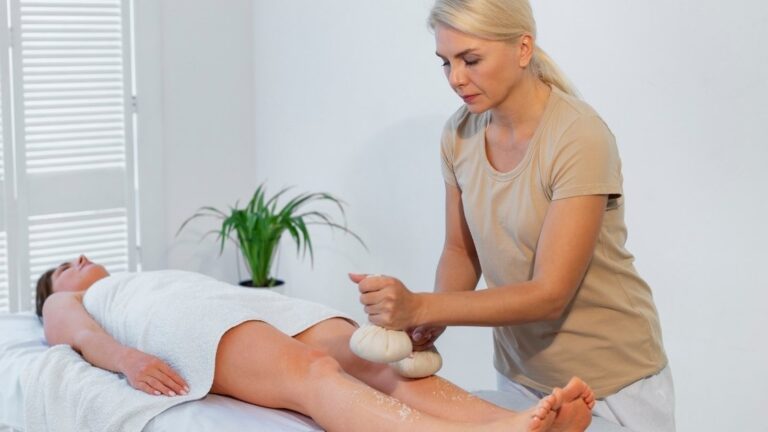
A 2020 systematic review in the International Journal of Neuroscience reported that regular massage reduces cortisol levels and increases serotonin production. That dual effect explains why stiffness often eases before the therapist’s pressure even addresses the underlying knot.
Rhythmic Movement and Walking
Gentle, repetitive motion signals safety to the nervous system. Walking is the most accessible form available. For the neurobiology of why a 20-minute walk often outperforms seated techniques, see our research-backed piece on walking for anxiety relief.
Cold Exposure
Brief cold water exposure activates the vagus nerve and reduces inflammation around tight muscle groups. Our evidence review on whether cold baths support muscle recovery covers a safe protocol worth trying.
Lifestyle Habits That Prevent Tension From Building Back
Releasing tension is half the battle. These daily defaults prevent it from reaccumulating in the same spots.
Take movement snacks every 45 minutes. Sitting longer than 90 minutes resets postural muscles into a contracted baseline, which is why office workers so reliably develop stress stored in muscles along the upper back.
Stay well hydrated. Dehydrated fascia is stickier and less elastic, which amplifies stiffness even when stress levels are under control. A rough target of 30 ml of water per kilogram of body weight daily works for most adults.

Protect sleep quality. Blue light after 9 p.m. keeps cortisol elevated and disrupts the jaw and shoulder release that happens during deep sleep stages. A phone curfew, even a loose one, often outperforms melatonin.
Practice body check-ins. Three times a day, drop your shoulders, unclench your jaw, and exhale for a slow six-count. Building this reflex is the core skill of mind body awareness, a capacity strongly linked to long-term stress resilience.
When to Consult a Professional
Home techniques handle everyday tension well. They are not a substitute for medical evaluation when something more serious may be present. See a physician if tension comes paired with numbness, radiating pain, persistent migraines, or disrupted breathing. Chronic pain lasting longer than three months warrants assessment by a licensed physical therapist or pain specialist. For tension tied to trauma history, somatic experiencing practitioners and therapists trained in body-based approaches often produce better results than talk therapy alone.
Sources
- American Psychological Association. “Stress Effects on the Body.” https://www.apa.org/topics/stress/body
- Harvard Health Publishing. “Understanding the Stress Response.” https://www.health.harvard.edu/staying-healthy/understanding-the-stress-response
- Allen, D.L. et al. “Myostatin, Activin Receptor IIb, and Follistatin-Like 3 Gene Expression Are Altered in Adipose Tissue and Skeletal Muscle of Obese Mice.” American Journal of Physiology, 2010. https://journals.physiology.org/doi/full/10.1152/ajpregu.00296.2010
- Kaiser Permanente. “Stress Management: Common Signs and Symptoms of Stress.” https://healthy.kaiserpermanente.org/health-wellness/health-encyclopedia/he.stress-management-common-signs-and-symptoms-of-stress.abo9926
- Field, T. et al. “Cortisol Decreases and Serotonin and Dopamine Increase Following Massage Therapy.” International Journal of Neuroscience. https://pubmed.ncbi.nlm.nih.gov/16162447/
Where does the body store emotional stress?
Emotional pressure most often accumulates in postural and reflexively tense muscle groups, according to the American Psychological Association. These include the upper trapezius across the neck and shoulders, the masseter in the jaw, the intercostals in the ribcage, the psoas at the hip flexors, and the lumbar erectors in the lower back.
Can emotions really get trapped in muscles?
Emotions are processed in the brain, but the physiological signature of an emotional event (elevated cortisol, shallow breathing, sustained muscle contraction) can persist in the tissue long after the feeling has faded. This explains why a deep stretch, massage, or breathwork session sometimes triggers an unexpected wave of tears or laughter.
How long does it take to release chronic muscle tension?
A single session of progressive muscle relaxation or professional massage can ease acute tightness within 10 to 20 minutes. Long-standing patterns built over months or years usually require two to six weeks of consistent daily practice before the nervous system genuinely resets its baseline. Consistency outperforms intensity every time.
Which muscles carry the most tension?
The upper trapezius ranks first, followed by the masseter and the psoas. The trapezius is directly wired into the fight-or-flight response, the jaw serves as a primary outlet for suppressed emotion, and the psoas contracts during every startle reflex, as Harvard Health Publishing explains in its stress response overview.
Does crying release muscle tension?
Often yes. Crying activates the parasympathetic nervous system and releases oxytocin and endorphins, which can soften clenched muscles in the chest, jaw, and shoulders. Many people report feeling physically lighter after a good cry, and that sensation reflects a real drop in muscle tone, not just a mood shift.
Can exercise make stored tension worse before it gets better?
Short term, sometimes yes. A new workout can briefly stir up dormant tension as tight tissues are asked to lengthen and contract under load. Gentle, progressive movement such as walking, restorative yoga, or swimming rarely produces this flare and remains the safest entry point for anyone who has been mostly sedentary.